
Article content
Argentina, the United States, and the Geopolitics of a World Cup at Home
By Not Nulled Labs · A Hybrid Core editorial experiment
On the night of June 16, 2026, in a stadium in Kansas City, a man aged 38 years and 357 days kicked a ball three times and rewrote the record books. Lionel Messi scored all three goals against Algeria, carried Argentina to a 3-0 win in its opening match, drew level with Miroslav Klose as the all-time top scorer in World Cup history, and became the oldest player ever to record a hat-trick at the tournament. It happened exactly twenty years after his first World Cup appearance. Twenty years on, he still decides games.
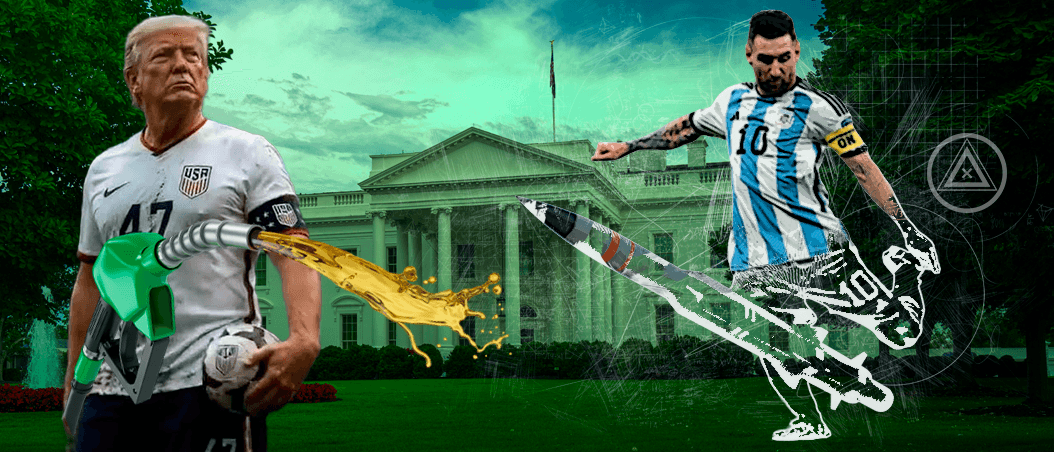
That image, the defending champion opening with authority on United States soil, feeds a very specific dream: a final between Argentina and the host, the United States, coached by an Argentine, on July 19 within sight of Manhattan. It is a perfect image. It reads like fiction. Which is exactly why it deserves suspicion.
This essay is not about who would lift the trophy. It is about a more uncomfortable question: how much does a World Cup actually move a country’s economy, politics, and mood, or are we overstating it because we need sport to mean more than sport? We write it under our Hybrid Core model, which is less a method than a posture: a person frames the hypothesis and decides, while the AI checks every figure, traces the knockout bracket match by match, and audits the evidence as far as it holds. We do not replace the analyst. We take the time to check what almost no one checks before forming an opinion.
Let us start with the number most people skip.
The Match That Almost Cannot Happen
Before debating the consequences of an Argentina versus United States final, we have to ask whether that final is even likely. The numbers are cold.
Prediction markets, which pool real money from thousands of traders, gave the United States roughly 1.2 to 1.7 percent odds of winning the tournament, with a realistic ceiling at the round of 16. Argentina sat near 9 to 10 percent. Converted into the odds of reaching the final, that puts Argentina at about one in five and the United States at roughly one in twenty-five. If both got there and landed in opposite halves, the chance the final is exactly those two is on the order of one in a hundred. Not impossible. Unlikely, and worth saying plainly before building a castle on top of it.
There is a bracket detail that feeds the myth, and the opening result just reinforced it. If Argentina wins Group J and the United States wins Group D, the two land in opposite halves and can meet only in the final. We verified this by tracing the official knockout structure: as group winners they end up in separate semifinals, with a single possible crossing point. The 3-0 nudges Argentina toward that top spot, which is the precondition for the whole theory. But the other half of the condition is fragile. If the United States finishes second in its group, it drops into Argentina’s half, and the two could knock each other out in the round of 16, which would make a final between them impossible. The “they can only meet in the final” story rests on an assumption that is not yet met.

What follows, then, is not a forecast. It is a map of what that result would move if it happened, and how much of that movement is real versus our own projection.
What a Win Would Move at the Ballot Box
The popular intuition says that if the host wins, the incumbent benefits. It is one of those beliefs that sound obvious and are almost never measured. Political science did measure it. The result is more interesting for being contested than for being settled.
In 2010, Andrew Healy, Neil Malhotra, and Cecilia Mo published a now-famous study in PNAS. Looking at American college football games just before elections, events no government can influence, they found that a local win in the ten days before a vote added 1.61 percentage points to the incumbent, with a larger effect where fan passion ran highest. The thesis was unsettling, and it has a name in cognitive psychology: Daniel Kahneman’s substitution heuristic. The voter swaps a hard question, is this government doing a good job, for an easy one that happens to be top of mind, do I feel good today. A sporting win, however irrelevant, lifts the mood.
Here is the honest part. In 2015, Anthony Fowler and Benjamin Montagnes reexamined the finding and concluded it was probably a false positive: if the effect were real, it should be largest where football interest is highest, and they found the opposite. It is the trap the statistician Andrew Gelman calls the garden of forking paths: with enough ways to slice the data, almost any correlation surfaces. The original authors replied, defending that, taken as a whole, the evidence shows wins do raise the incumbent’s vote. The dispute is still open, and that is precisely why it is useful. There is no comfortable truth to headline.
Now think about scale. The original study measured college teams with regional audiences. A World Cup is a different beast. In the United States, the 2014 final drew about 26.5 million viewers, a record for a football match in that country, where the sport is still called soccer. The 2022 Argentina versus France final drew roughly 25.8 million, the second most-watched in US history. The 2022 United States versus England group match pulled in 19.9 million. And the 2026 tournament is at home, which historically sends engagement soaring. American interest in the game went from marginal to mass in a single generation.
We do not claim that winning a World Cup decides an election. We hand the arithmetic to the reader. If a mood effect on the order of that 1.6 percent existed and scaled with audience size, then across tens of millions of people the number stops being trivial. And modern elections turn on razor-thin margins. In Peru, the June 7, 2026 runoff still had no declared winner more than a week later: with 99 percent of ballots counted, the two candidates were separated by about 33,000 votes out of more than 18 million, and the lead changed hands several times during the count. One point, sometimes a few hundred votes, changes history.
Two honest brakes remain. The effect is still debated, not proven. And the calendar does not cooperate: the final is in July and the United States midterms are in November, while the mechanism Healy measured works over days, not months. We are not selling certainty. We hand over the question with its limits in plain sight.
But there is one arena where the World Cup’s influence stops being a hypothesis and turns into hard cash. To see it, look behind the stadium.
The Board Behind the Stadium
If the electoral layer is slippery, the geopolitical one is concrete, and it is moving as we write.
While the World Cup unfolds on United States soil, Washington and Tehran are finalizing the so-called Islamabad Memorandum of Understanding, mediated by Pakistan, after the conflict that erupted in late February 2026. The draft covers fourteen points: a halt to hostilities, the reopening of the Strait of Hormuz, and a sixty-day window to negotiate Iran’s nuclear program. Signing is expected this week. This is not idle talk. It comes with official statements and a market already reacting.
Because the war hit wallets directly, and that is where sport meets the real economy. When operations began, Brent crude jumped from around 71 dollars and at one point passed 100, with the Strait of Hormuz, through which roughly 20 percent of the world’s crude flows, effectively shut. United States gasoline climbed about 30 percent in March. Then, as the deal grew imminent, Brent collapsed: on June 16 it fell nearly 5 percent to around 80 dollars, a three-month low, down close to 30 percent on the month. The logic is direct, and it is playing out in real time: if the deal holds and Hormuz reopens, prices ease, and with them one of the main sources of consumer discontent in the United States.
Let us add the pieces with care. A home World Cup, a possible host victory, a war winding down, and cheaper fuel compose, in theory, a feel-good climate hard to ignore in an election year. Political science has names for this: John Mueller’s rally-round-the-flag effect, the bump in support a leader gets in moments of external tension, and the old suspicion of the diversionary use of force. But climate is not cause. Temporal correlation seduces and deceives. Sport illustrates the mood of an era far better than it produces it, and oil answers to geopolitics, not to goals.
Even so, when the host wins, the suspicion arrives on its own. It is worth understanding where it comes from, because it says something about us.
Why We Always Suspect the Host
Every time a country hosts a World Cup and does well, the suspicion appears. “It’s all fixed.” That sentence deserves rigor, not outrage, because it holds a real seed and an illegitimate leap, and telling them apart is the whole exercise.
The real seed is home advantage, among the best-measured phenomena in sport. In football, the home side wins around 68 percent of matches, excluding draws, across samples of tens of thousands of games. Part of that edge comes from the referee. In a classic experiment by Nevill, Balmer, and Williams (2002), forty officials watched the same incidents: those who heard the crowd penalized the home team significantly less than those who watched in silence. The pandemic offered the natural experiment: with empty stadiums, home advantage and referee bias both shrank, as Sors and colleagues documented (2020). The bias is real, psychological, and unconscious. And six host nations have won the World Cup, which gives the suspicion statistical fuel.
The illegitimate leap is going from “there is a measurable home advantage” to “this tournament is rigged for the United States.” There is no evidence of that, and asserting it would defame real people and institutions without proof. What science describes is an effect of environment on human decisions, not a conspiracy. The truly interesting question is not whether the World Cup is fixed, but why our minds leap so fast from a documented bias to a deliberate plot. Nassim Taleb called it the narrative fallacy, and psychologists call it apophenia: the compulsion to see intent where there is only pattern. That impulse says more about how we handle uncertainty than about FIFA.
And the need for the result to mean something grows sharper the more the underlying reality hurts. Few realities hurt like the one waiting on the other side of the champion.
A Trophy on Cracked Ground
Media attention tends to settle on the host, but the more meaning-laden half of that hypothetical final is the other one. Argentina does not arrive as just any finalist. It arrives as defending champion and, at the same time, in a delicate economic moment.
The data, with no partisan reading, simply as context. Inflation has been slowing: according to INDEC it was 2.1 percent monthly in May 2026, 33.2 percent year over year, far below earlier peaks. That is one side of the coin. The other is purchasing power. Formal registered wages have lost around 15 percent in real terms since November 2023, the month before the devaluation that opened the cycle, and the minimum wage has fallen by roughly a third, to buying-power levels not seen since the 2001 crisis, according to studies by the University of Buenos Aires and CIFRA. Mass consumption has been shrinking for over a year. Two truths at once: prices rise more slowly, and the wallet is still bruised.
Why does this matter for an essay about football? Because sport lands differently depending on the emotional ground it falls on. The anthropologist Clifford Geertz, in his essay “Deep Play” on the Balinese cockfight, showed that a game is never only a game: it is the story a society tells itself about itself. Émile Durkheim called it collective effervescence, the moment a crowd feels, for a while, like a single body. Argentina has a documented relationship between its titles and its catharses: 1978, under a military dictatorship; 1986, emerging from that dictatorship and a lost war; 2022, in the middle of yet another economic crisis. If something like the mood effect Healy proposes exists, a country strained by the cost of living is, in theory, more fertile ground for it than a prosperous, distracted one. It is a hypothesis, not a certainty. But it is the anthropological question a serious analysis should not dodge: what a trophy means to a society watching it through uncertainty.
So, Are We Overstating It?
Probably yes, and that is the most honest thing we can write.
The bracket math says the final itself is about a one-in-a-hundred event. The electoral effect is in academic dispute and, on top of that, poorly matched to the calendar. The geopolitical link is real in its parts, the Iran deal and the oil price already falling, but symbolic in its connection to a result on the pitch. The fixing suspicion confuses a measured bias with a nonexistent intent. Added up, the pieces suggest a World Cup moves far less than the hype promises.

And yet we cannot stop running the scenarios. We project onto ninety minutes of play our economic anxieties, our electoral tensions, our theories about power. That is the real finding, the one that survives all the skepticism: not football’s influence on reality, but the intensity with which we need it to have one. The match decides no elections and signs no treaties, but it works as the clearest screen we have to see, all at once and in real time, what a society is worried about.
The final Washington didn’t order may never be played. The one that always is, is the one each of us projects onto it. The question we leave open is not who would win, but why it matters to us so much that someone does.
References
- Healy, A. J., Malhotra, N., & Mo, C. H. (2010). Irrelevant events affect voters’ evaluations of government performance. PNAS, 107(29), 12804-12809. https://doi.org/10.1073/pnas.1007420107
- Fowler, A., & Montagnes, B. P. (2015). College football, elections, and false-positive results in observational research. PNAS, 112(45), 13800-13804. https://doi.org/10.1073/pnas.1502615112
- Healy, A., Malhotra, N., & Mo, C. H. (2015). Determining false-positives requires considering the totality of evidence. PNAS, 112(48), E6591. https://doi.org/10.1073/pnas.1518074112
- Kahneman, D. (2011). Thinking, Fast and Slow. Farrar, Straus and Giroux (substitution heuristic).
- Gelman, A., & Loken, E. (2013). The garden of forking paths. Columbia University.
- Mueller, J. E. (1970). Presidential popularity from Truman to Johnson (rally-round-the-flag). American Political Science Review, 64(1), 18-34.
- Geertz, C. (1972). Deep Play: Notes on the Balinese Cockfight. Daedalus, 101(1), 1-37.
- Taleb, N. N. (2007). The Black Swan (narrative fallacy).
- Nevill, A. M., Balmer, N. J., & Williams, A. M. (2002). The influence of crowd noise and experience upon refereeing decisions in football. Psychology of Sport and Exercise, 3(4), 261-272. https://doi.org/10.1016/S1469-0292(01)00033-4
- Sors, F., Grassi, M., Agostini, T., & Murgia, M. (2020). The sound of silence in association football. European Journal of Sport Science, 21(11), 1597-1605. https://doi.org/10.1080/17461391.2020.1845814
- INDEC, Consumer Price Index, May 2026; CIFRA-CTA and UBA-IIEP real-wage and minimum-wage reports (2024-2026).
- US World Cup television audiences: FIFA, Nielsen, Fox, Telemundo (2014, 2018, 2022).
- US-Iran Memorandum of Understanding and oil market: Congress.gov/CRS, CNBC, Trading Economics, Fortune (June 2026).
- Peru 2026 presidential runoff: ONPE official count (June 2026).
- Argentina’s 2026 World Cup debut: FIFA, La Nación, ESPN (June 16, 2026).
- World Cup 2026 odds on prediction markets (June 2026).